Identifying the GAA repeat expansion

Genetic tests, such as the Southern blot or polymerase chain reaction (PCR), can confirm suspicions of Friedreich’s ataxia (FA) by detecting abnormal GAA repeat expansions.1 An expanded GAA repeat is a key indicator of FA, with greater expansions correlating with disease severity.2

Genetic testing can help reveal if a person is a carrier of FA and if there’s a risk of passing it on to future children. It can also help identify the disease in relatives or siblings who are asymptomatic.3

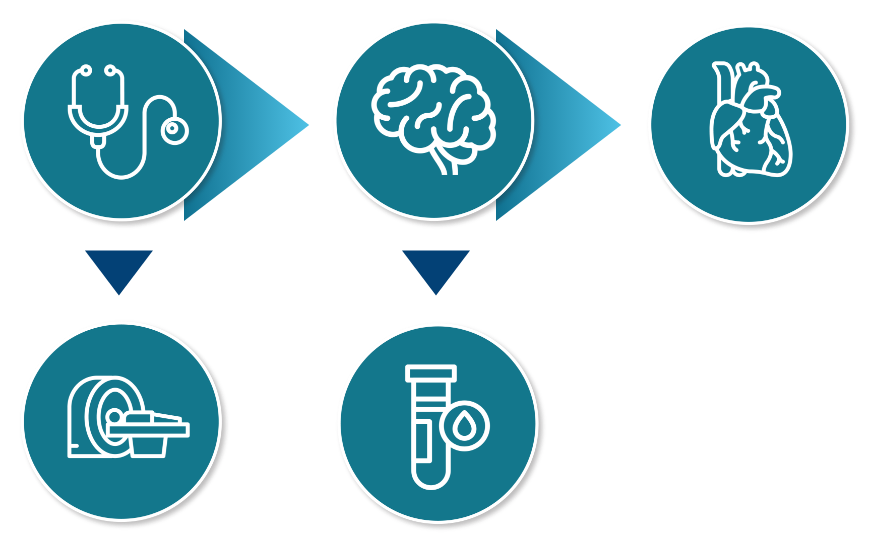
An electromyogram (EMG), nerve conduction studies, an electrocardiogram (ECG), an echocardiogram, blood tests, and magnetic resonance imaging (MRI) or computed tomography (CT) scans can also aid in the diagnosis of FA.3

A clinician conducting genetic testing.

Clinical cases

Early and accurate diagnosis of FA is critical due to the progressive nature of the disease. Studies have shown that younger patients progress faster than patients with intermediate to late onset.4,5

Examine these hypothetical patient cases for insights on how the time of onset affects the disease course.

  • Select a case study:
  • Present Illness

    History of present illness

    Caeleb is a previously healthy 6-year-old boy who presented to his pediatrician with a several-month history of difficulty running, playing, and general clumsiness. His parents report that he had been becoming gradually more unsteady, with frequent tripping and difficulty maintaining balance while running.

    Eventually, they noticed that he rarely ran, skipped, or hopped during any playtime compared with his younger brother. Over the last several months, he only walked upstairs easily, and has been noticeably hesitant while descending stair flights.

    The schoolyard monitor reported to the parents Caeleb “could not keep up” with other students during recess kickball games and had quite frequently tripped or fallen during games of tag. There is no known history of trauma, infections, headaches, seizures, or visual disturbances. Caeleb does not wear glasses, and vision has been 20/20.

  • Family & Social History

    Family history

    No known family history of neuromuscular or neurodegenerative disorders. Parents are nonconsanguineous. Some paternal aunts and uncles are reported to have type 2 diabetes, and a first cousin is known to have systemic juvenile idiopathic arthritis (SJIA). Maternal family is positive for Alzheimer disease.


    Social history

  • Examination & Labs

    Physical examination

    General

    well-nourished, well-groomed, cooperative boy in no acute distress


    Neurologic

    • √

      Alert and interactive with his surroundings

    • √

      No evidence of deficits in attention or responsiveness

    • √

      Cranial nerves grossly intact, no evidence of extraocular movements

    • √

      Gait: wide-based, mildly unsteady, focuses on staying close to objects near him while walking


    Cardiac and Respiratory

    • √

      No murmurs, rubs, or gallops

    • √

      In office ECG: normal sinus rhythm, with no traces of ectopy

    • √

      Lungs are clear to auscultation bilaterally


    The rest of the physical exam is unremarkable. The pediatrician assures the parents that Caeleb is simply undergoing “growing pains” and is still on track with developmental milestones. The parents remain unconvinced but accept the assessment.

    Laboratory findings

    All unremarkable.

  • Follow-Up

    Follow-Up

    Approximately 4 months later, the parents return with Caeleb, who was unable to participate in any running and jumping activities for a field day at school. The teacher observed him fall twice and sustain an abrasion on his hand.

    Caeleb then asked to stand with his teacher and just watch the rest of the time. None of the other >100 children were reported to withdraw from the activities.


    Possible neurological diagnosis

  • Specialist Referral

    Pediatric neurologist

    The pediatric neurologist observes Caeleb’s wide-based, mildly unsteady gait, with focus on objects in front of him while walking, and performs the following tests:

    • √

      Romberg test: positive

    • √

      Coordination: mild dysmetria on finger-to-nose and heel-to-shin testing; slightly slower rapid alternating movements in the hands (dysdiadochokinesia); performance further degrades with multistep tasks

    • √

      Reflexes: upper and lower extremity reflexes normal; Babinski absent

    • √

      Speech: normal and age-appropriate

    • √

      Agnosia, apraxia, or dysphagia: absent

  • Assessment

    Pediatric neurologist assessment

    • ataxia icon

      The pediatric neurologist suspects a cerebellar ataxia of unknown origin due to the early age of onset and opts for a complete workup.

    • mri icon

      An MRI was read as “Normal of the brain and spine for age with no focal lesions, no cerebellar or brainstem atrophy evident, and cord caliber grossly normal.”

    • genetic-testing icon

      Among a comprehensive panel, genetic testing is positive for a GAA trinucleotide repeat expansion in the FXN gene, confirming Friedreich’s ataxia.

History of present illness

Caeleb is a previously healthy 6-year-old boy who presented to his pediatrician with a several-month history of difficulty running, playing, and general clumsiness. His parents report that he had been becoming gradually more unsteady, with frequent tripping and difficulty maintaining balance while running.

Eventually, they noticed that he rarely ran, skipped, or hopped during any playtime compared with his younger brother. Over the last several months, he only walked upstairs easily, and has been noticeably hesitant while descending stair flights.

The schoolyard monitor reported to the parents Caeleb “could not keep up” with other students during recess kickball games and had quite frequently tripped or fallen during games of tag. There is no known history of trauma, infections, headaches, seizures, or visual disturbances. Caeleb does not wear glasses, and vision has been 20/20.

Family history

No known family history of neuromuscular or neurodegenerative disorders. Parents are nonconsanguineous. Some paternal aunts and uncles are reported to have type 2 diabetes, and a first cousin is known to have systemic juvenile idiopathic arthritis (SJIA). Maternal family is positive for Alzheimer disease.


Social history

Physical examination

General

well-nourished, well-groomed, cooperative boy in no acute distress


Neurologic

  • √

    Alert and interactive with his surroundings

  • √

    No evidence of deficits in attention or responsiveness

  • √

    Cranial nerves grossly intact, no evidence of extraocular movements

  • √

    Gait: wide-based, mildly unsteady, focuses on staying close to objects near him while walking


Cardiac and Respiratory

  • √

    No murmurs, rubs, or gallops

  • √

    In office ECG: normal sinus rhythm, with no traces of ectopy

  • √

    Lungs are clear to auscultation bilaterally


The rest of the physical exam is unremarkable. The pediatrician assures the parents that Caeleb is simply undergoing “growing pains” and is still on track with developmental milestones. The parents remain unconvinced but accept the assessment.

Laboratory findings

All unremarkable.

Follow-Up

Approximately 4 months later, the parents return with Caeleb, who was unable to participate in any running and jumping activities for a field day at school. The teacher observed him fall twice and sustain an abrasion on his hand.

Caeleb then asked to stand with his teacher and just watch the rest of the time. None of the other >100 children were reported to withdraw from the activities.


Possible neurological diagnosis

Pediatric neurologist

The pediatric neurologist observes Caeleb’s wide-based, mildly unsteady gait, with focus on objects in front of him while walking, and performs the following tests:

  • √

    Romberg test: positive

  • √

    Coordination: mild dysmetria on finger-to-nose and heel-to-shin testing; slightly slower rapid alternating movements in the hands (dysdiadochokinesia); performance further degrades with multistep tasks

  • √

    Reflexes: upper and lower extremity reflexes normal; Babinski absent

  • √

    Speech: normal and age-appropriate

  • √

    Agnosia, apraxia, or dysphagia: absent

Pediatric neurologist assessment

  • ataxia icon

    The pediatric neurologist suspects a cerebellar ataxia of unknown origin due to the early age of onset and opts for a complete workup.

  • mri icon

    An MRI was read as “Normal of the brain and spine for age with no focal lesions, no cerebellar or brainstem atrophy evident, and cord caliber grossly normal.”

  • genetic-testing icon

    Among a comprehensive panel, genetic testing is positive for a GAA trinucleotide repeat expansion in the FXN gene, confirming Friedreich’s ataxia.

  • Present Illness

    History of present illness

    Rosalie is a previously healthy 12-year-old active girl, who presents with worsening balance during physical education, especially at kickboxing and jujitsu.

    She now has noticeable balance loss with most types of kicks and punches, along with increased reluctance to participate in grappling. She is often thrown to the mat now when she previously excelled at competition and had been invited several times for regional tournaments. She experiences frequent falls during sparring drills, and her brown belt testing has been delayed several times due to not meeting technical standards when she had previously advanced rapidly.

    Her parents also report that she has been especially unsteady when walking in dim lighting or on uneven surfaces. She has difficulty descending stairs without the handrail, but ascending is less affected. She often walks with a wider gait and an arm slightly outstretched in front of her. The parents have become very concerned with her falling asleep very early in the evening, decreased physical coordination, and multiple unsatisfactory grades in gym class.

    There is no known history of trauma, infections, headaches, seizures, or visual disturbances. Her vision is corrected to 20/20 with glasses.


  • Family & Social History

    Family history

    No known family history of neuromuscular or neurodegenerative disorders. Parents are nonconsanguineous. Maternal grandmother died suddenly of a massive pulmonary embolism; paternal grandfather had multiple extended hospitalizations for aspergillosis pneumonia. Positive extended family history for acute myeloid leukemia (AML).


    Social history

  • Examination & Labs

    Physical examination

    General

    well-nourished, well-groomed, cooperative girl in no acute distress


    Neurologic

    • √

      Alert and interactive with her surroundings

    • √

      No evidence of deficits in attention or responsiveness

    • √

      Cranial nerves grossly intact, no evidence of extraocular movements

    • √

      Gait: wide-based, unsteady, dominant arm held out toward near objects or wall while walking


    Cardiac and Respiratory

    • √

      No murmurs, rubs, or gallops

    • √

      In office ECG: normal sinus rhythm, no traces of ectopy, and a left ventricular strain pattern (V1 S wave + V5 R wave > 35 mm)

    • √

      Lungs are clear to auscultation bilaterally

    The rest of the physical exam is unremarkable.

    Laboratory findings

    All unremarkable.

  • Initial Assessment

    Initial assessment

    Possible neurological diagnosis

  • Specialist Referral

    Pediatric neurologist

    The pediatric neurologist observes the wide-based, unsteady gait, with the dominant arm lightly outstretched while walking, and performs the following tests:

    • √

      Romberg test: positive

    • √

      Coordination: mild dysmetria on heel-to-shin, delay on rapid alternating hand movements, and subtle overshoot on finger-to-nose after repeated attempts; moderate difficulty at executing karate stance transitions when asked to demonstrate (needed postural rest or reset)

    • √

      Reflexes: upper limbs: 2+; lower limbs: diminished (1+ at knees, trace at ankles); Babinski absent

    • √

      Speech: normal and age-appropriate

    • √

      Agnosia, apraxia, or dysphagia: absent

  • Final Assessment

    Final assessment

    The pediatric neurologist is highly suspicious of ataxia due to the obvious difficulty in balance and the relative ease of fatigue. An ordered MRI was read as

    • cerebellar icon

      Normal cerebellar volume; no white matter changes

    • mri icon

      Cervical spine with subtle reduction in spinal cord diameter, consistent with early posterior column involvement; no T2 signal change


    Among a comprehensive panel, genetic testing is positive for a lengthy GAA trinucleotide repeat expansion in the FXN gene, confirming Friedreich’s ataxia.

History of present illness

Rosalie is a previously healthy 12-year-old active girl, who presents with worsening balance during physical education, especially at kickboxing and jujitsu.

She now has noticeable balance loss with most types of kicks and punches, along with increased reluctance to participate in grappling. She is often thrown to the mat now when she previously excelled at competition and had been invited several times for regional tournaments. She experiences frequent falls during sparring drills, and her brown belt testing has been delayed several times due to not meeting technical standards when she had previously advanced rapidly.

Her parents also report that she has been especially unsteady when walking in dim lighting or on uneven surfaces. She has difficulty descending stairs without the handrail, but ascending is less affected. She often walks with a wider gait and an arm slightly outstretched in front of her. The parents have become very concerned with her falling asleep very early in the evening, decreased physical coordination, and multiple unsatisfactory grades in gym class.

There is no known history of trauma, infections, headaches, seizures, or visual disturbances. Her vision is corrected to 20/20 with glasses.

Family history

No known family history of neuromuscular or neurodegenerative disorders. Parents are nonconsanguineous. Maternal grandmother died suddenly of a massive pulmonary embolism; paternal grandfather had multiple extended hospitalizations for aspergillosis pneumonia. Positive extended family history for acute myeloid leukemia (AML).


Social history

Physical examination

General

well-nourished, well-groomed, cooperative girl in no acute distress


Neurologic

  • √

    Alert and interactive with her surroundings

  • √

    No evidence of deficits in attention or responsiveness

  • √

    Cranial nerves grossly intact, no evidence of extraocular movements

  • √

    Gait: wide-based, unsteady, dominant arm held out toward near objects or wall while walking


Cardiac and Respiratory

  • √

    No murmurs, rubs, or gallops

  • √

    In office ECG: normal sinus rhythm, no traces of ectopy, and a left ventricular strain pattern (V1 S wave + V5 R wave > 35 mm)

  • √

    Lungs are clear to auscultation bilaterally

The rest of the physical exam is unremarkable.

Laboratory findings

All unremarkable.

Initial assessment

Possible neurological diagnosis

Pediatric neurologist

The pediatric neurologist observes the wide-based, unsteady gait, with the dominant arm lightly outstretched while walking, and performs the following tests:

  • √

    Romberg test: positive

  • √

    Coordination: mild dysmetria on heel-to-shin, delay on rapid alternating hand movements, and subtle overshoot on finger-to-nose after repeated attempts; moderate difficulty at executing karate stance transitions when asked to demonstrate (needed postural rest or reset)

  • √

    Reflexes: upper limbs: 2+; lower limbs: diminished (1+ at knees, trace at ankles); Babinski absent

  • √

    Speech: normal and age-appropriate

  • √

    Agnosia, apraxia, or dysphagia: absent

Final assessment

The pediatric neurologist is highly suspicious of ataxia due to the obvious difficulty in balance and the relative ease of fatigue. An ordered MRI was read as

  • cerebellar icon

    Normal cerebellar volume; no white matter changes

  • mri icon

    Cervical spine with subtle reduction in spinal cord diameter, consistent with early posterior column involvement; no T2 signal change


Among a comprehensive panel, genetic testing is positive for a lengthy GAA trinucleotide repeat expansion in the FXN gene, confirming Friedreich’s ataxia.

  • Present Illness

    History of present illness

    Jacob is a previously healthy 21-year-old young man in trade school as an electrician’s apprentice for 2 years. At first, he was able to carry heavy cable rolls up multiple flights of stairs but now needs to use a hand truck after lunch. He needs to take frequent breaks when running sets of heavier wire. Six months ago, he started having significant difficulty with wiring large circuit boxes, due to dexterity challenges and fatigue near the end of a shift.

    He recently missed 1 week of work after cutting himself with a cable shearer, which required 11 stitches in his hand. Over the last year, due to obvious changes in his gait, job supervisors have inquired multiple times whether he was injured or even intoxicated on a site. Slurring of his words have been noted when conversing for long periods of time with supervisors. He has been sent home from a site 2 separate times after falling off a ladder and has been reprimanded for making inaccurate bends and cuts in electrical conduits.

    At Christmas, his visiting brother immediately noticed changes in the way he walked and his great difficulty with cutting vegetables. The brother sat Jacob aside and pleaded with him to see a doctor.

  • Family & Social History

    Family history

    No known family history of neuromuscular or neurodegenerative disorders. Parents are nonconsanguineous; maternal grandparents died years ago, and paternal grandparents are currently alive and healthy.


    Social history

  • Examination & Labs

    Physical examination

    General

    well-developed man, mildly disheveled work clothes, fatigued-appearing but cooperative, with no acute distress


    Neurologic

    • √

      Alert, oriented ×4, appropriate affect; no cognitive impairment

    • √

      Cranial nerves grossly intact, no evidence of extraocular movements

    • √

      Mild dysarthria noted during H and P questioning; visible left-hand scar that has healed appropriately; noticeable calluses on both palms

    • √

      Gait: wide-based, unsteady, frequent resets needed when asked to walk, turn, and then return; fatigue apparent with repeated testing


    Cardiac and Respiratory

    • √

      Lungs clear to auscultation bilaterally

    • √

      Soft systolic murmur at left sternal border

    • √

      ECG: sinus rhythm with occasional PACs, T-wave inversions in lateral leads with borderline LV strain pattern; normal QRS width and no prolonged PR interval

    Laboratory findings

    All unremarkable.

  • Initial Assessment

    Initial Assessment

    The assessing physician refers Jacob to neurology for evaluation of progressive ataxia and neuropathy and asks Jacob to consider a cardiology workup due to ECG/murmur findings, unexplained fatigue, and possible syncope risk. They also order vitamin B12, thyroid, CMP, CBC, and heavy metal panels, all of which return unremarkable except a mildly elevated serum creatinine at 1.2. Jacob is advised to limit energy drinks and ibuprofen use. An MRI is ordered for 2 weeks in consultation with the neurologist Jacob will see.

    Complex neurological assessment and recommendations

  • Specialist Referral

    General neurologist

    The neurologist notices Jacob’s unsteady gait and need for intermittent 3-point contact with fingers on the wall while walking back to the exam room.

    Coordination:

    • √

      Marked dysmetria on heel-to-shin

    • √

      Dysdiadochokinesia on rapid alternating hand movements

    • √

      Finger-to-nose shows overshoot, worsens with repetition


    Gait:

    • √

      Wide-based, staggering gait; reduced push-off and heel strike

    • √

      Frequent lateral sway, especially during turns; need for fixation upon distant objects

    • √

      Unable to perform tandem walk

    • √

      Positive Romberg test with loss of balance


    Reflexes:

    • √

      Biceps, brachioradialis: 2+

    • √

      Ankles: 1+

    • √

      Knees: 1+

    • √

      Babinski: mute bilaterally

    Fatigability was present on repeated foot tapping and a fine wire manipulation simulation, and mild pes cavus was noted bilaterally. MRI was read overall as cerebellar volume preserved; no diffuse cerebellar cortical atrophy; thoracic spinal cord thinning; cervical cord slightly narrowed but less severe than thoracic; and no focal lesions, masses, or demyelinating plaques.

  • Final Assessment

    Final assessment

    The neurologist was highly suspect of hereditary ataxia due to the gradual, steady progression and the MRI findings but is apprehensive about considering a concrete diagnosis due to the later onset in life.

    The neurologist orders a vitamin E panel for AVED, SCA1/2 for spinocerebellar ataxia, and a trinucleotide repeat assay for Friedreich’s ataxia.

    • dx icon

      The report returns as FXN GAA repeat analysis:

      • Expanded allele 1: 370 GAA repeats
      • Expanded allele 2: 227 GAA repeats
      • No normal alleles detected

History of present illness

Jacob is a previously healthy 21-year-old young man in trade school as an electrician’s apprentice for 2 years. At first, he was able to carry heavy cable rolls up multiple flights of stairs but now needs to use a hand truck after lunch. He needs to take frequent breaks when running sets of heavier wire. Six months ago, he started having significant difficulty with wiring large circuit boxes, due to dexterity challenges and fatigue near the end of a shift.

He recently missed 1 week of work after cutting himself with a cable shearer, which required 11 stitches in his hand. Over the last year, due to obvious changes in his gait, job supervisors have inquired multiple times whether he was injured or even intoxicated on a site. Slurring of his words have been noted when conversing for long periods of time with supervisors. He has been sent home from a site 2 separate times after falling off a ladder and has been reprimanded for making inaccurate bends and cuts in electrical conduits.

At Christmas, his visiting brother immediately noticed changes in the way he walked and his great difficulty with cutting vegetables. The brother sat Jacob aside and pleaded with him to see a doctor.

Family history

No known family history of neuromuscular or neurodegenerative disorders. Parents are nonconsanguineous; maternal grandparents died years ago, and paternal grandparents are currently alive and healthy.


Social history

Physical examination

General

well-developed man, mildly disheveled work clothes, fatigued-appearing but cooperative, with no acute distress


Neurologic

  • √

    Alert, oriented ×4, appropriate affect; no cognitive impairment

  • √

    Cranial nerves grossly intact, no evidence of extraocular movements

  • √

    Mild dysarthria noted during H and P questioning; visible left-hand scar that has healed appropriately; noticeable calluses on both palms

  • √

    Gait: wide-based, unsteady, frequent resets needed when asked to walk, turn, and then return; fatigue apparent with repeated testing


Cardiac and Respiratory

  • √

    Lungs clear to auscultation bilaterally

  • √

    Soft systolic murmur at left sternal border

  • √

    ECG: sinus rhythm with occasional PACs, T-wave inversions in lateral leads with borderline LV strain pattern; normal QRS width and no prolonged PR interval

Laboratory findings

All unremarkable.

Initial Assessment

The assessing physician refers Jacob to neurology for evaluation of progressive ataxia and neuropathy and asks Jacob to consider a cardiology workup due to ECG/murmur findings, unexplained fatigue, and possible syncope risk. They also order vitamin B12, thyroid, CMP, CBC, and heavy metal panels, all of which return unremarkable except a mildly elevated serum creatinine at 1.2. Jacob is advised to limit energy drinks and ibuprofen use. An MRI is ordered for 2 weeks in consultation with the neurologist Jacob will see.

Complex neurological assessment and recommendations

General neurologist

The neurologist notices Jacob’s unsteady gait and need for intermittent 3-point contact with fingers on the wall while walking back to the exam room.

Coordination:

  • √

    Marked dysmetria on heel-to-shin

  • √

    Dysdiadochokinesia on rapid alternating hand movements

  • √

    Finger-to-nose shows overshoot, worsens with repetition


Gait:

  • √

    Wide-based, staggering gait; reduced push-off and heel strike

  • √

    Frequent lateral sway, especially during turns; need for fixation upon distant objects

  • √

    Unable to perform tandem walk

  • √

    Positive Romberg test with loss of balance


Reflexes:

  • √

    Biceps, brachioradialis: 2+

  • √

    Ankles: 1+

  • √

    Knees: 1+

  • √

    Babinski: mute bilaterally

Fatigability was present on repeated foot tapping and a fine wire manipulation simulation, and mild pes cavus was noted bilaterally. MRI was read overall as cerebellar volume preserved; no diffuse cerebellar cortical atrophy; thoracic spinal cord thinning; cervical cord slightly narrowed but less severe than thoracic; and no focal lesions, masses, or demyelinating plaques.

Final assessment

The neurologist was highly suspect of hereditary ataxia due to the gradual, steady progression and the MRI findings but is apprehensive about considering a concrete diagnosis due to the later onset in life.

The neurologist orders a vitamin E panel for AVED, SCA1/2 for spinocerebellar ataxia, and a trinucleotide repeat assay for Friedreich’s ataxia.

  • dx icon

    The report returns as FXN GAA repeat analysis:

    • Expanded allele 1: 370 GAA repeats
    • Expanded allele 2: 227 GAA repeats
    • No normal alleles detected
  • Present Illness

    History of present illness

    Helena is a 32-year-old female accountant who presents with a several-year history of intermittent gait instability and on-and-off fatigue that has gradually worsened. She initially noticed difficulty during her evening barre classes, particularly with single-leg balance and lunge sequences. She began using the barre for support more often, attributing the changes to lax conditioning and extended desk time. Over the last 18 months, coworkers have commented on her occasional “duck walk” when moving quickly between meeting rooms and her tripping on office floor transitions. She stopped wearing high heels due to increased ankle wobbling and has had pain in the bottom of her feet she assumed was aggravated plantar fasciitis.

    She has not had any falls with injury, but she has dropped her laptop 4 times in the past 6 months. She also has noticed a new hand clumsiness when handling small fasteners on jewelry and buttons, as well as fatigue by late afternoon when typing long spreadsheets. Her speech is normal except for occasional voice strain when tired. Symptoms improve slightly with rest but have progressed despite exercise classes and orthotics. She became concerned when she could not complete a new-style exercise class due to balance issues and worsening exhaustion, along with her smart watch notifying her numerous times of an “irregular heartbeat.” At a recent prenatal ob-gyn visit, the physician observed her wide gait, difficulty with her buttons, and mildly slurred sleech and referred her to a neurologist for evaluation.

  • Family & Social History

    Family history

    She was adopted at age 2 years, and no biological family medical history is available.


    Social history

  • Examination & Labs

    Physical examination

    General

    well-appearing, well-dressed woman in no acute distress but endorses a feeling of palpitations now


    Neurologic

    • √

      Mental status: alert, oriented, intact attention

    • √

      Cranial nerves: intact, full ocular motility, no extraocular movement

    • √

      Speech: mildly strained after prolonged counting test but not dysarthric

    • √

      Motor: full strength throughout, no fasciculations or tremor but fatigues with repeated testing


    Cardiac and Respiratory

    • √

      Lungs clear to auscultation bilaterally; no murmurs, rubs, or gallops

    • √

      ECG: atrial fibrillation at 80 to 90 bpm, no evidence of LV strain pattern, normal QRS width; prior ECG was normal 2 years ago


    Gait

    • √

      Wide-based, mildly staggering gait, reduced push-off and heel strike

    • √

      Positive Romberg test with drift

    • √

      Difficulty with tandem gait, deviates 1 to 2 steps

    • √

      Unable to balance on 1 leg for more than a few seconds


    Coordination

    • √

      Mild dysmetria on finger-to-nose and heel-to-shin testing

    • √

      Dysdiadochokinesia on rapid alternating hand movements


    Laboratory findings

    All unremarkable.

  • Initial Assessment

    General neurologist assessment

    MRI brain and spine: normal cerebellar volume, no cortical atrophy, no demyelinating lesions, mild thoracic and cervical cord thinning noted

    • dx icon

      Given the late onset of the signs and symptoms and no obtainable family history, the neurologist is highly uncertain about hereditary ataxia. He suggests a wide genomic panel to rule out irreversible causes, which returns a diagnosis of late-onset FA.

History of present illness

Helena is a 32-year-old female accountant who presents with a several-year history of intermittent gait instability and on-and-off fatigue that has gradually worsened. She initially noticed difficulty during her evening barre classes, particularly with single-leg balance and lunge sequences. She began using the barre for support more often, attributing the changes to lax conditioning and extended desk time. Over the last 18 months, coworkers have commented on her occasional “duck walk” when moving quickly between meeting rooms and her tripping on office floor transitions. She stopped wearing high heels due to increased ankle wobbling and has had pain in the bottom of her feet she assumed was aggravated plantar fasciitis.

She has not had any falls with injury, but she has dropped her laptop 4 times in the past 6 months. She also has noticed a new hand clumsiness when handling small fasteners on jewelry and buttons, as well as fatigue by late afternoon when typing long spreadsheets. Her speech is normal except for occasional voice strain when tired. Symptoms improve slightly with rest but have progressed despite exercise classes and orthotics. She became concerned when she could not complete a new-style exercise class due to balance issues and worsening exhaustion, along with her smart watch notifying her numerous times of an “irregular heartbeat.” At a recent prenatal ob-gyn visit, the physician observed her wide gait, difficulty with her buttons, and mildly slurred sleech and referred her to a neurologist for evaluation.

Family history

She was adopted at age 2 years, and no biological family medical history is available.


Social history

Physical examination

General

well-appearing, well-dressed woman in no acute distress but endorses a feeling of palpitations now


Neurologic

  • √

    Mental status: alert, oriented, intact attention

  • √

    Cranial nerves: intact, full ocular motility, no extraocular movement

  • √

    Speech: mildly strained after prolonged counting test but not dysarthric

  • √

    Motor: full strength throughout, no fasciculations or tremor but fatigues with repeated testing


Cardiac and Respiratory

  • √

    Lungs clear to auscultation bilaterally; no murmurs, rubs, or gallops

  • √

    ECG: atrial fibrillation at 80 to 90 bpm, no evidence of LV strain pattern, normal QRS width; prior ECG was normal 2 years ago


Gait

  • √

    Wide-based, mildly staggering gait, reduced push-off and heel strike

  • √

    Positive Romberg test with drift

  • √

    Difficulty with tandem gait, deviates 1 to 2 steps

  • √

    Unable to balance on 1 leg for more than a few seconds


Coordination

  • √

    Mild dysmetria on finger-to-nose and heel-to-shin testing

  • √

    Dysdiadochokinesia on rapid alternating hand movements


Laboratory findings

All unremarkable.

General neurologist assessment

MRI brain and spine: normal cerebellar volume, no cortical atrophy, no demyelinating lesions, mild thoracic and cervical cord thinning noted

  • dx icon

    Given the late onset of the signs and symptoms and no obtainable family history, the neurologist is highly uncertain about hereditary ataxia. He suggests a wide genomic panel to rule out irreversible causes, which returns a diagnosis of late-onset FA.

In a national survey of 50 physicians who treat patients with FA: 94% believe FA identification, management, and optimal treatment demands diligence and taking a holistic view of the disease.6

holistic icon